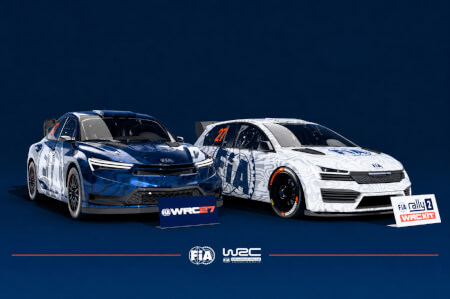




FIA reveals WRC27 Rally1 concept
First approved by the World Motor Sport Council in 2024, the WRC27 regulations are designed to reset rallying’s top category - reducing costs and increasing accessibility, while preserving the performance and spectacle that sit at the heart of the WRC.
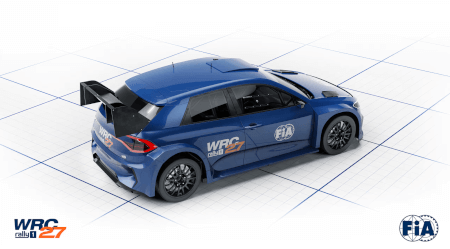
The newly revealed concept turns that framework into a tangible design, showing how the regulations could be applied across a range of vehicle styles and interpretations by future Constructors.
At its core is a tubular frame safety cell, evolving the structure introduced with the current Rally1 cars in 2022. Developed through simulation, benchmarking and prototype crash testing, the new cell delivers high levels of occupant protection while reducing overall complexity and cost, with improved intrusion resistance and energy absorption across all major impact scenarios.
At its core is a tubular frame safety cell, evolving the structure introduced with the current Rally1 cars in 2022. Developed through simulation, benchmarking and prototype crash testing, the new cell delivers high levels of occupant protection while reducing overall complexity and cost, with improved intrusion resistance and energy absorption across all major impact scenarios.
That safety-led foundation is surrounded by a bodywork framework designed to give Constructors far greater freedom. Rather than requiring cars to be derived from current production models, the regulations define a reference volume within which all exterior panels must sit. Within that space, Constructors are free to develop anything from production-inspired designs to bespoke rally concepts, while simplified aerodynamic devices aim to keep development costs in check.
The WRC27 regulations also broaden the definition of who can compete at the top level. Manufacturers and tuners will compete under a single classification of Constructor, with responsibility for design, construction, homologation and marketing of the car. The move is intended to widen participation and strengthen competition in the championship’s premier category.
The WRC27 regulations also broaden the definition of who can compete at the top level. Manufacturers and tuners will compete under a single classification of Constructor, with responsibility for design, construction, homologation and marketing of the car. The move is intended to widen participation and strengthen competition in the championship’s premier category.
Performance remains central to the package. WRC27 cars will initially be powered by a sustainably fuelled 1.6-litre turbocharged internal combustion engine producing around 290 horsepower, paired with four-wheel drive and a five-speed gearbox. Double wishbone suspension is specified, with braking and steering systems derived from Rally2 regulations to deliver a high-performance but more accessible platform.
The cars will be built within a defined footprint, with lengths between 4100mm and 4300mm and a maximum width of 1875mm, allowing significant freedom of design within clear limits. The framework also allows for future powertrain flexibility, leaving the door open for alternative technologies later in the cycle.
Cost reduction has been a central objective. The price of a ready-to-compete Tarmac-specification car will be capped at €345,000 - more than 50 per cent lower than the outgoing Rally1 formula - with further savings targeted through improved durability, limits on personnel, reduced logistics and greater use of remote engineering support.
WRC Promoter Director of Sport Peter Thul welcomed the emphasis on affordability as the championship looks towards 2027.
WRC Promoter Director of Sport Peter Thul welcomed the emphasis on affordability as the championship looks towards 2027.
“We as the Promoter welcome the new regulations which put a major focus on affordability,” he said. “We are absolutely confident this will lead to an increase in manufacturers and now constructors competing at the pinnacle of our sport.”
FIA President Mohammed Ben Sulayem said the regulations marked a defining moment for the championship.
“The WRC27 regulations represent a pivotal moment for the FIA World Rally Championship,” he said. “They establish a framework focused on cost control, sustainability and accessibility, while safeguarding the performance and technical challenge that define rallying at the highest level.”
FIA Deputy President for Sport Malcolm Wilson said flexibility had been a defining principle.
“The new Rally1 concepts that we have released have been designed to these specifications, demonstrating how that flexibility can be applied in practice,” he said. “They highlight, for the first time, the range of technical solutions and vehicle concepts that can be developed within the framework.”
For more Industry News, please Click Here
For more Industry News, please Click Here