



IndyCar Series reveals new-for-2028 chassis
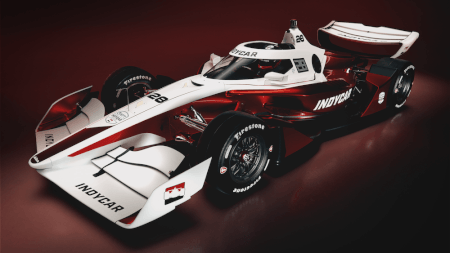
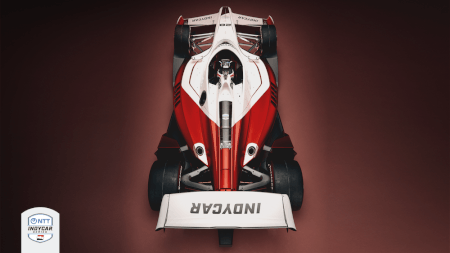
The IndyCar Series has revealed its new-for-2028 chassis, Dallara’s Indy Racing 28 (IR28).
“We are pleased to unveil renderings of the new chassis that will take our sport into an exciting new era,” said IndyCar president Doug Boles.
“As you can imagine, a project of this magnitude takes an incredible amount of planning, collaboration and execution. I would like to thank all of our partners including Dallara, Chevrolet, Honda, Firestone and Shell, who have worked tirelessly to create a package that will enhance IndyCar’s already incredible competition and industry-leading growth.”
The IR28 will replace the Dan Wheldon 12 (DW12) at the end of the 2027 season, and soon, renderings of the IR28 will be replaced with a real car. As RACER revealed during the recent Nashville IndyCar event, the IR28 is set to break cover later this week and perform validation testing with a new unbadged 2.4-liter twin-turbo V6s engine supplied by Ilmor, makers of Chevy's engines.
The venue has not been confirmed by the series, but the Indianapolis Motor Speedway road course would be the closest option for the series and its vendors. Just prior to May’s running of the Indy 500, a pair of IR28 prototype tubs arrived at Dallara USA’s base next to IMS, and it’s believed both will take part in the test with their respective 2.4s installed.
“With initial testing to begin this week, there is still plenty of work to do before 2028, but we are well on our way to showcasing a new era of IndyCar, which will include enhanced wheel-to-wheel competition, track records, standards in raceability and new benchmarks in safety,” Boles said.
“With initial testing to begin this week, there is still plenty of work to do before 2028, but we are well on our way to showcasing a new era of IndyCar, which will include enhanced wheel-to-wheel competition, track records, standards in raceability and new benchmarks in safety,” Boles said.
“We are confident the IR-28 is the ideal package to move IndyCar forward for our teams, drivers, partners and fans.”
Compared to the existing and highly stressed 2.2-liter twin-turbo V6s supplied by Chevy and Honda, the increase of 200ccs should allow for more power to be made without placing the 2.4-liter units under the same extreme internal pressures. The previous target of 800hp has been reduced to a starting point of 760hp, with the goal to reach 800hp in the future.
A brand-new six-speed transmission from Xtrac was commissioned to deliver the hybrid power through a lighter design. Weight savings have been found throughout the car, but the new transmission is said to be the largest contributor to the mass reduction initiative with the carving of 25 pounds from the DW12’s gearbox.
Bridging the engine and transmission, a significant alteration was made to the bellhousing design in order to fit a larger battery pack for the car’s all-new low-voltage hybrid system.
Like the more robust 2.4-liter combustion engines, the new energy storage system (ESS) and motor generator unit (MGU) form a package that’s intended to contribute more power – approximately 100hp, which is roughly double what’s on tap in the DW12, has been the ambition held by the series – and for a longer duration, thanks to the added space created to install more capacity in the ESS.
A complete change in hybrid vendors has been orchestrated, with Spain’s BOLD Technology responsible for a switch from supercapacitors to a battery-based ESS that IndyCar says will offer 14 times the energy storage over the DW12’s system. The motor generator unit (MGU) is being handled by England’s Helix, which serves as a supplier to Formula 1 and Formula E teams. Together, the IR28’s hybrid package is expected to come in 20 pounds lighter than the existing system made by Skeleton (ESS) and Empel (MGU).
A complete change in hybrid vendors has been orchestrated, with Spain’s BOLD Technology responsible for a switch from supercapacitors to a battery-based ESS that IndyCar says will offer 14 times the energy storage over the DW12’s system. The motor generator unit (MGU) is being handled by England’s Helix, which serves as a supplier to Formula 1 and Formula E teams. Together, the IR28’s hybrid package is expected to come in 20 pounds lighter than the existing system made by Skeleton (ESS) and Empel (MGU).
IndyCar says the collective weight loss efforts for the IR28 will lead to a completed car that weights 100 pounds less than the DW12.
Dallara is responsible for the majority of the IR28 chassis design. After team owners were shown the first version of the car, which was met with unflattering responses late in 2024, the series took the feedback to heart and incorporated styling assistance from IndyCar’s Tino Belli and digital artist Chris Beatty, which led to the visuals shown here.
The IR28 incorporates an aeroscreen that was part of the car’s original concept, which is a change from the 2012’s DW12 which had its first aeroscreen bolted atop the car as an add-on safety device in 2020. As a result, the IR28’s titanium halo, carbonfiber frame, and laminate screen blend into the new car far more harmoniously. The sides of the aeroscreen bring a return of digital information panels to IndyCar; multiple versions were tried and ultimately abandoned on the DW12.
For more information: www.racer.com
For more Industry News, please Click Here
For more information: www.racer.com
For more Industry News, please Click Here