


Technical Deep Dive: Why Torque Alone Doesn’t Tell the Whole Story
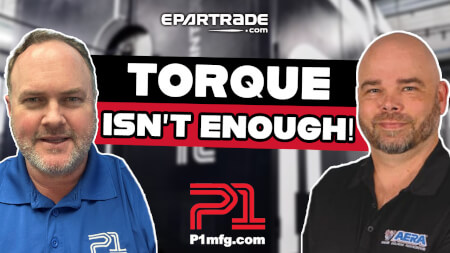
In a recent episode of EPARTRADE’s Race Industry Now webinar series, P1 Manufacturing and the Automotive Engine Rebuilders Association (AERA) delivered a highly technical and insightful discussion that challenged one of the most fundamental assumptions in engine assembly: that torque equals clamping force.
Titled “Is Your Torque Wrench Telling the Whole Story? The Facts About Torque Input, Clamp Load, and Friction,” the session featured Shannon Strother, Director of Future Technology at P1 Manufacturing, and Chuck Lynch, Vice President of Technical Service at AERA, and was hosted by Brad Gillie of SiriusXM.
Rethinking Torque: A Misleading Measurement
At the core of the discussion was a critical point: torque is only an indirect indicator of clamp load.
While torque wrenches are widely used across motorsports and engine building, Strother emphasized that torque is simply the input force applied to a fastener. What actually matters is the resulting clamp load, the tensile force that holds components together.
The problem lies in the fact that up to 85–90% of applied torque is lost to friction, primarily in:
- Thread interfaces
- Under-head or nut bearing surfaces
This leaves only a small percentage of torque contributing to actual bolt stretch and clamping force.
As a result, two identical torque values can produce dramatically different clamp loads depending on friction conditions.
The Role of Friction: The Hidden Variable
Friction emerged as the dominant variable influencing fastener performance.
The presenters highlighted how variations in lubrication, surface finish, coatings, and material interfaces can significantly alter friction coefficients. Even minor inconsistencies can lead to:
- Under-clamping (risking joint separation or fatigue failure)
- Over-clamping (risking fastener yield or component distortion)
Strother detailed how modern coatings and surface treatments are being engineered specifically to control friction behavior, improving consistency and predictability in clamp load outcomes.
This is particularly critical in high-performance racing engines, where tolerances are tight and loads are extreme.
Clamp Load Consistency: The Real Objective
The session reinforced that consistent clamp load—not torque—is the true objective in fastener installation.
Lynch explained that many engine failures traced back to “torque issues” are actually clamp load inconsistencies caused by uncontrolled friction variables.
To address this, the presenters discussed several advanced approaches:
- Use of torque-angle methods to better control bolt stretch
- Implementation of load-indicating fasteners or direct measurement tools
- Standardization of lubrication and installation procedures
- Increased reliance on engineered coatings to reduce variability
These methods aim to reduce the uncertainty inherent in torque-based assembly.
Torque vs. Tension: Moving Toward More Accurate Methods
A key takeaway from the webinar is the growing industry shift toward direct tension measurement.
While torque wrenches remain practical and widely used, they are inherently limited. Advanced applications, particularly in professional motorsports, are increasingly adopting:
- Ultrasonic bolt measurement systems
- Strain-based monitoring techniques
- Precision fastener engineering with controlled friction characteristics
These technologies allow builders to measure what actually matters: bolt stretch and resulting clamp load.
Implications for Engine Builders and Race Teams
For engine builders, race teams, and performance engineers, the implications are significant:
- Torque specs alone should not be treated as absolute
- Friction conditions must be controlled and repeatable
- Lubrication choice is a critical engineering decision, not a minor detail
- Fastener coatings and materials can directly impact engine reliability
As Strother noted during the session, “If you’re not controlling friction, you’re not controlling clamp load.”
Raising the Standard in Fastener Technology
This webinar reflects a broader evolution in the racing industry: a shift toward data-driven assembly practices and precision engineering.
By challenging long-standing assumptions and introducing more accurate methodologies, companies like P1 Manufacturing, alongside organizations like AERA, are helping elevate the standards of engine assembly and reliability.
For more information, watch the full webinar here.