



Lola unveils reborn T70S, a classic design infused with modern materials
Lola is manufacturing cars once again, with the news that the legendary T70 will be reborn as a limited run model, the T70S.
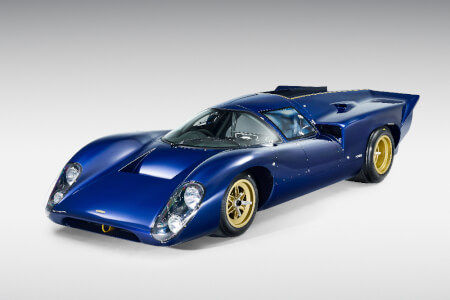
Limited to just 16 examples, the car will be available as a track or road variant, and is produced with the help of original archive drawings and high-resolution scans of surviving examples from the '60s.
“The T70 is not only one of Lola’s greatest designs, but one of the most iconic racing cars ever built,” said Till Bechtolsheimer, chairman of Lola Cars. “The T70S represents an entirely unique example of preserving motorsport heritage while advancing sustainable innovation; a car identical to the original fire-spitting, Steve McQueen-era, V8 monster, but refined with advanced manufacturing processes, sustainable materials and an unparalleled attention to detail.”
The T70S is the main track-only variant of the reborn car. It is built upon a lightweight aluminum monocoque chassis, with power coming from a 5.0-liter Chevrolet V8 engine pushing out 530bhp, with a "calculated" power-to-weight ratio of 616bhp per ton.
Other headline performance figures are a top speed of 203mph, and the 0-60 dash being completed in 2.5 seconds. The drivetrain features a period-correct transaxle and double wishbone suspension system, meaning that driving dynamics won't be unlike the original, and it also comes with an FIA Historic Technical Passport enabling it to compete in historic motorsport.
The T70S GT (pictured above) is the road-going variant, but performance remains close to the track car. This time the engine's 6.2-liter small block Chevrolet V8 produces just 30 horsepower less than the regular T70S, while the top speed is 200mph and 0-60 is handled in 2.9s.
The T70S GT (pictured above) is the road-going variant, but performance remains close to the track car. This time the engine's 6.2-liter small block Chevrolet V8 produces just 30 horsepower less than the regular T70S, while the top speed is 200mph and 0-60 is handled in 2.9s.
While retaining much of the DNA of the track car, there are also subtle changes to improve usability, such as refinements to the ergonomics, storage compartments, and climate control.
The engine and the gearbox it’s mated to have been refined specifically for road use, while the dampers have also been given similar attention – Lola says such refinements have been done with “restraint” to preserve the car’s driving dynamics and not change them too much between the track and road variants. Lola calls its principle, “respectful refinement”, meaning that rather than reinterpret the original as many brands do, it has chosen to improve on what was already done, using modern approaches free of the constraints that it would have had to contend with in the past.
“Driving the T70S will be a chance to experience the past and future of motorsport simultaneously,” said Lola Cars technical director Peter McCool. “An entirely unique example of groundbreaking innovation in advanced sustainable materials, this project provides a blueprint for the future of historic motoring and motorsport.”
Setting it apart from the original examples is the introduction of the Lola Natural Composite System (LNCS), which is a patent-pending solution for the car's bodywork that features a combination of natural plant and basalt fibers as well as a fully renewable resin system derived from sugar cane processing waste.
The end result is a body that's entirely free of petrochemicals, but also one that has superior tensile strength and stiffness compared to traditional glass fiber composites, and improved impact damage tolerance compared to glass-reinforced plastic and carbon fiber.
Elsewhere in the car’s production, magnesium used is extracted from seawater via solar-powered electrolysis – a process that is believed to be a first for the automotive space – which eliminates the need for energy-intensive mining and refining, while innovative casting techniques and alternative shielding gases are also used to reduce environmental impact without impacting material integrity.
Elsewhere in the car’s production, magnesium used is extracted from seawater via solar-powered electrolysis – a process that is believed to be a first for the automotive space – which eliminates the need for energy-intensive mining and refining, while innovative casting techniques and alternative shielding gases are also used to reduce environmental impact without impacting material integrity.
All of this means that Lola has achieved a reduction of approximately 54% in CO₂ emissions compared with conventional manufacturing benchmarks, with certain components – such as the aforementioned magnesium – increasing that figure to 80%.
“The T70S project forms part of Lola’s broader strategic focus on cutting-edge performance technologies,” said Lola Cars CEO Mishern Chetty. “Since 2022, as part of our mission to drive innovation through motorsport, we have invested heavily in the development of advanced materials, powertrain systems and supply chain innovations aimed at reducing the carbon footprint of high-performance vehicles.”
The original Lola T70 was popular in the 1960s, with more than 100 being built and taking more than 230 race wins and 348 podiums during its lifespan while being driven by the likes of John Surtees, Jackie Stewart and Mario Andretti.
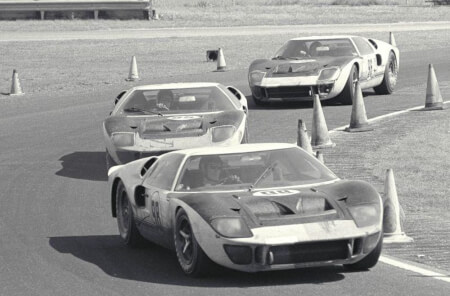
It won the first Can-Am championship in 1966 with Surtees before McLaren’s domination took hold, and later won the 24 Hours of Daytona in 1969 where it beat the works Ford GT40s and Porsche 908s with Mark Donohue and Chuck Parsons driving for Team Penske.